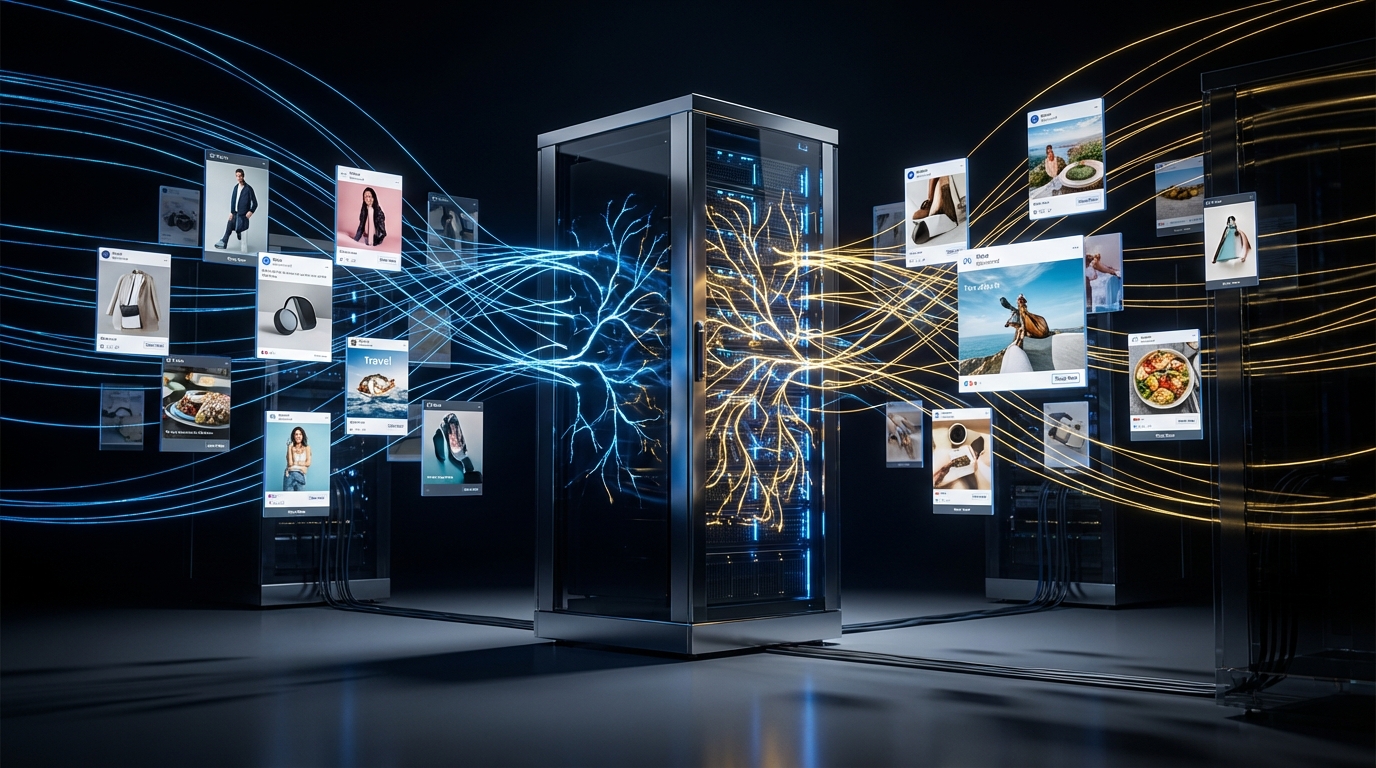
Meta plans to offer fully automated AI-generated ads by the end of 2026 — where an advertiser inputs a product URL and a budget, and AI handles everything else (Marketing Dive, 2025). That’s not a vague roadmap. That’s a deadline. And if you’re a media buyer who still thinks your value is in audience targeting and bid management, this should make you uncomfortable.
I’ve managed over $50M in Meta ad spend across 15+ DTC brands. I was at Meta working with 30+ agencies before I started running accounts myself. So when I say the job of “media buyer” is about to look completely different — I’m not guessing. I’m watching it happen in my own accounts, right now.
But here’s the thing most people get wrong: full automation doesn’t mean media buyers disappear. It means the ones who can’t adapt will. And the ones who understand what AI actually does well (and where it still falls short) are about to become far more valuable.
This piece breaks down what Meta’s automation timeline really means, what’s already changed, and how I’m adjusting my own approach to stay ahead of it.
TL;DR: Meta’s full AI ad automation by end of 2026 will handle creative generation, targeting, and optimization from a single product URL. But only 6% of marketers have fully implemented AI (Supermetrics, 2026). The media buyers who win won’t fight automation — they’ll master creative strategy and AI-human collaboration where machines still struggle.
What Does Meta’s Full AI Ad Automation Actually Look Like?
By the end of 2026, Meta’s vision is straightforward: you give it a product image or URL plus a budget, and AI generates the creative, selects the audience, optimizes delivery, and handles attribution (Marketing Dive, 2025). Nearly 2 million advertisers already use Meta’s AI creative tools, with adoption jumping 20% quarter-over-quarter (Meta Q2 2025 Earnings).
That sounds like the end of media buying, right? Not exactly. What it means is the tactical layer — the campaign setup, audience building, bid adjustments — gets absorbed into the machine. The 10+ million active advertisers on Meta’s platform will all have access to the same automation. So where does differentiation come from?
Here’s what I’ve noticed in my accounts: The more I lean into Advantage+ automation, the more my job shifts toward creative strategy and data interpretation. I’m spending less time in Ads Manager and more time deciding what story to tell and how to read the signals the algorithm gives back. That’s not less work — it’s different work.
Think about it this way. When everyone has the same autopilot, the pilot who understands turbulence still matters. Meta’s AI doesn’t know your brand positioning. It doesn’t understand why your Q4 creative needs a different emotional register than your prospecting ads in January. It optimizes for the metric you give it — but choosing the right metric, at the right time, for the right segment? That’s still a human call.
The infrastructure behind this shift is real. Meta’s Generative Ads Engine (GEM) is 4x more efficient at driving ad performance gains compared to their original recommendation models (Search Engine Land, 2025). And the Andromeda algorithm has shifted targeting from audience-first to creative-first matching. Your creative is your targeting now.
How Is the Andromeda Algorithm Changing Who Sees Your Ads?
70-80% of Meta ad performance is now driven by creative strength and quality, not budget or targeting (AppsFlyer 2025 Creative Optimization Report). That number would’ve been unthinkable three years ago when audience targeting was the whole game. Andromeda completed its global rollout in October 2025, and it fundamentally rewired how Meta matches ads to people.
The old model: you built audiences, Meta showed your ads to those audiences. The new model: you provide creative, and Andromeda figures out who resonates with it. Creative is now the primary targeting signal. This isn’t a subtle shift — it’s the entire paradigm flipping.
What does this mean in practice? In my accounts, I’ve stopped spending time on lookalike audience refinement. Instead, I’m testing more creative variations and letting Advantage+ figure out who they resonate with. The ROAS difference is significant: Advantage+ Shopping campaigns achieve an average $4.52 ROAS versus $3.70 for manual campaigns — a 22% lift (Growth Foundry, 2026). CPA reductions range from 9% to 32% depending on industry.
What I’ve seen firsthand: When I stopped trying to outsmart Advantage+ Audience targeting on a supplements client last quarter, CPA dropped 18% in two weeks. The algorithm already knew things about our audience that my manual segments couldn’t capture. My value shifted to feeding it better creative — not telling it who to show ads to.
Advantage+ Audience also delivers 13% lower median cost per catalog sale, 7% lower cost per website conversion, and 28% lower cost per click for lead generation (Meta via Coinis, 2025). These aren’t marginal improvements. They’re the kind of numbers that make manual targeting hard to justify for most campaigns.
What Is Meta’s Ranking Engineer Agent — and Why Should You Care?
On March 17, 2026, Meta published something that most media buyers missed entirely: the Ranking Engineer Agent (REA). It’s an autonomous AI system that doubled average model accuracy across six ad ranking models and delivered a 5x increase in engineering output — three engineers accomplished what previously required two engineers per model (Engineering at Meta, 2026).
Why does this matter for you? Because REA accelerates how fast Meta improves its ad delivery algorithms. The ranking models that determine which ads get shown to which people are now being optimized by AI agents, not just human engineers. That means the pace of algorithmic change is about to accelerate dramatically.
If you’re still running the same campaign structures you used six months ago without retesting, you’re already behind. The system you’re advertising on is changing faster than most people realize — and it’s changing autonomously.
Combined with GEM and Andromeda, REA creates a feedback loop: AI agents improve the ranking models, which improve ad delivery, which generates more performance data, which feeds back into model training. For AI agents in Meta Ads Manager, this is just the beginning. The implications are massive for anyone managing campaigns at scale.
Do AI-Generated Ads Actually Outperform Human-Created Ones?
A 2026 study by researchers at Columbia, Harvard, Carnegie Mellon, and TU Munich analyzed over 500 million impressions and 3 million clicks. AI-generated ads achieved a 0.76% average CTR compared to 0.65% for human-made ads (Taboola, 2026). But here’s the nuance that matters: AI ads that didn’t “look like AI” achieved the highest engagement of all groups.
That finding tells you everything about where the value lies. Raw AI output isn’t the winner. AI output that’s been guided by someone who understands brand voice, emotional triggers, and creative storytelling — that’s what performs. Right now, 30% of ad creative is built from scratch or enhanced using generative AI, expected to reach 40% in 2026 (ANA, 2025).
Here’s where consumer trust gets interesting. 48% of consumers trust ads co-created by a person with AI, versus only 13% who trust fully AI-created ads (Smartly.io, 2025). The market is explicitly telling us: human-AI collaboration beats full automation on trust. That’s the moat for skilled media buyers and creative strategists.
From my own testing: I ran a side-by-side creative test for a beauty DTC client — 10 fully AI-generated ad variants versus 10 human-directed variants where I wrote the brief and the AI executed. The human-directed batch outperformed on ROAS by 23% and had a 40% lower cost per acquisition. The AI could execute, but it needed a human telling it what to execute.
This mirrors what the AI creative testing data keeps showing: the compounding advantage goes to teams that use AI as an accelerant for human creative judgment, not a replacement for it.
Why Are 30% of Agency Leaders Calling AI Their Biggest Threat?
The Foxwell Founders 2026 survey — 550+ agency members managing over $1 billion in monthly ad spend — found that 30% of agency leaders cite AI as the single biggest threat to their business in the next 12-24 months (GlobeNewsWire, 2026). Another 29% cite in-housing as their top concern — and AI is making in-housing easier.
But here’s the paradox. While agency leaders are worried about AI, the data shows most marketers haven’t actually figured it out yet. Only 6% of marketers have fully implemented AI, despite 80% feeling pressure to adopt it — and 89% of that pressure comes from the C-suite (Supermetrics, 2026). Only 18% report high trust in their AI implementations.
That gap between pressure and implementation is where the real opportunity lives. If you’re a media buyer or agency operator who actually knows how to work with AI — not just talk about it — you’re in a tiny minority. The 30% who are scared? They should be scared. Not because AI replaces them, but because the 6% who figure it out will take their clients.
The agency threat isn’t automation itself. It’s that AI-driven budget allocation and creative generation tools make it possible for lean, AI-native teams to outperform large agencies with slower adoption cycles. When a two-person team with AI can do what a ten-person team does manually, the economics shift fast.
What Should Media Buyers Actually Do Right Now?
Meta generated $196.18 billion in ad revenue in 2025 — a 22% year-over-year increase — with over 10 million active advertisers on the platform (Meta Investor Relations, 2026). The money flowing into the system is growing, not shrinking. What’s changing is who captures value from that spend.
Here’s the framework I’m using in my own accounts right now:
1. Shift from audience architect to creative strategist. Andromeda and Advantage+ handle audience matching better than you can manually. Your time is better spent on creative briefs, emotional hooks, and brand storytelling. If you’re still spending hours building custom audiences, you’re optimizing the wrong layer. Read the Advantage+ Audience targeting guide to understand why.
2. Build AI-human creative workflows. Don’t hand everything to AI. Don’t ignore it either. The sweet spot — the one the CTR data supports — is human direction with AI execution. Write the brief. Define the emotional angle. Let AI generate 50 variations. Then use AI analytics to identify which creative elements drive performance.
3. Master measurement, not just metrics. As automation handles more of the tactical work, the ability to interpret results and make strategic decisions becomes your differentiator. Understanding incrementality, media mix modeling, and AI-driven attribution is what separates operators from button-pushers. I’ve written about building a measurement framework beyond last-click attribution for exactly this reason.
4. Test faster than the algorithm changes. REA means Meta’s ranking models are improving at an accelerating rate. Your testing cadence needs to match. If you’re running the same creative for more than two weeks without new variants, you’re falling behind the system’s learning speed.
5. Stop fighting Advantage+ — learn to steer it. The data is clear: Advantage+ Shopping campaigns outperform manual campaigns by 22% on ROAS. Your job isn’t to outperform the machine on targeting — it’s to give the machine better inputs and interpret its outputs more intelligently than your competitors do.
Is Full Automation the End of Media Buying as a Profession?
No. But it’s the end of media buying as most people currently practice it. The tactical button-pushing — audience creation, bid adjustment, placement optimization — that’s getting automated. Not in five years. Now. The AI for Meta Ads playbook I wrote covers the broader shift, and everything since then has confirmed the trajectory.
What won’t get automated is creative judgment. Brand strategy. Understanding why a supplements brand needs a different creative approach than an apparel brand. Reading the data and deciding to pivot from UGC to polished brand content in week three of a campaign because the numbers tell a story the algorithm can’t interpret on its own.
My take: The media buyers who thrive in 2026 and beyond won’t call themselves media buyers. They’ll be “AI-directed performance strategists” or something equally awkward — but the point is the role evolves from execution to orchestration. You’re not driving the car anymore. You’re programming the route and deciding when to override the GPS.
Meta’s $196 billion ad revenue machine isn’t going away. The 10 million advertisers aren’t leaving. What’s happening is the barrier to running ads is dropping to zero — and that means the value of running them well is about to skyrocket. If you can combine creative strategy, data interpretation, and AI fluency, you’re not being replaced. You’re about to be in very high demand.
Frequently Asked Questions
Will Meta’s AI completely replace human media buyers by 2027?
No. Meta’s full automation handles campaign setup, targeting, and optimization — but only 6% of marketers have fully implemented AI (Supermetrics, 2026). Creative strategy, brand judgment, and cross-channel decisions still require human expertise. The role changes from executor to orchestrator.
How much better do Advantage+ campaigns perform versus manual campaigns?
Advantage+ Shopping campaigns deliver an average $4.52 ROAS versus $3.70 for manual campaigns — a 22% improvement. Advantage+ Audience shows 13% lower cost per catalog sale and 28% lower cost per lead (Meta via Coinis, 2025). Results vary by industry, with CPA reductions ranging from 9% to 32%.
Do AI-generated ads actually get more clicks than human-created ads?
Yes — but with a catch. A study across 500M+ impressions found AI-generated ads achieved 0.76% CTR versus 0.65% for human-created ads (Taboola/Columbia/Harvard, 2026). However, 48% of consumers trust human-AI co-created ads versus only 13% for fully AI-created ones (Smartly.io, 2025). The best results come from human-directed AI execution.
What is Meta’s Ranking Engineer Agent (REA)?
REA is an autonomous AI system that Meta uses to improve its ad ranking models. It doubled average model accuracy across six models and increased engineering output 5x (Engineering at Meta, 2026). For advertisers, this means Meta’s ad delivery algorithm improves faster than ever — making your testing cadence more important than your targeting skills.
What skills should media buyers develop to stay relevant?
Focus on creative strategy, data interpretation, and AI-human collaboration workflows. The Foxwell 2026 survey shows 45% of agencies cite ad production as their biggest challenge (GlobeNewsWire, 2026). Media buyers who can direct AI to produce better creative and interpret performance data at scale will command premium value.
The Bottom Line
Meta’s full AI ad automation isn’t a threat to good media buyers. It’s a threat to mediocre ones. The same tools that make it possible for anyone to run ads also make it possible for skilled operators to run them at a scale and sophistication that wasn’t possible before.
Here’s what to take away:
- Creative is the new targeting. Andromeda’s creative-first matching means your ad quality matters more than your audience settings.
- AI-human collaboration wins. AI-generated ads get more clicks, but human-directed AI creative gets more trust and better ROAS.
- The adoption gap is your advantage. Only 6% of marketers have fully implemented AI. Being in that group puts you years ahead.
- Test faster. REA is accelerating algorithmic change. Your testing cadence needs to keep pace.
- Shift up the value chain. From button-pushing to strategy. From audience building to creative direction. From campaign management to business intelligence.
The automation wave is real — and it extends beyond paid ads into how AI is reshaping brand discovery. But it’s not a wall — it’s a wave you can ride. The question isn’t whether AI changes media buying. It already has. The question is whether you change with it.