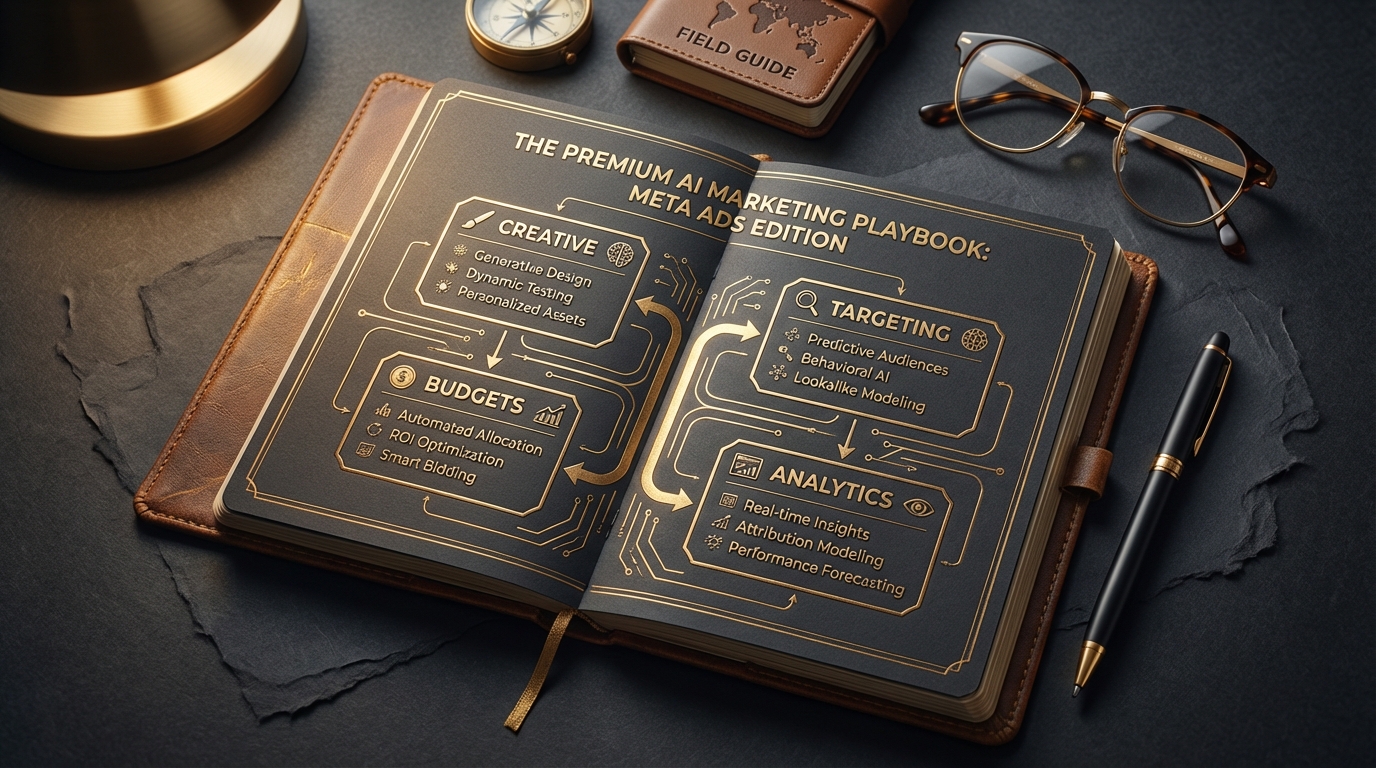
If you’re running Meta ads in 2026 and you’re not using AI, you’re leaving money on the table. Full stop.
I’ve managed millions in ad spend across Meta platforms, and the shift I’ve seen over the past 18 months is unlike anything in the decade before it. AI hasn’t just changed how we optimize campaigns — it’s fundamentally changed what’s possible with paid media budgets of any size.
Here’s the practical, no-fluff guide to using AI for Meta ads — the strategies I actually use with clients, not the theoretical stuff you’ll find in most marketing blogs.
Updated July 2026: Meta’s native AI now returns $4.13 in revenue for every $1 spent, up 25% since 2022 (Meta for Business, 2026), and 8 million advertisers use its generative-AI creative tools (PPC Land, 2026). Two newer pieces to know: GEM, the ranking brain Meta shipped in November 2025 (Meta Engineering, 2025), and Brand Memory, the brand-aware AI creative system previewed at Cannes in June 2026. Before buying an AI ad tool, check whether Meta already does the job free — see my Meta native AI vs. third-party tools buyer’s guide.
Why AI and Meta Ads Are a Perfect Match
Meta’s advertising platform already runs on machine learning. Advantage+ campaigns, broad targeting, dynamic creative — these are all AI-driven features baked into Ads Manager. But most advertisers barely scratch the surface.
The real leverage comes when you layer your own AI workflows on top of Meta’s native intelligence. You’re essentially giving the algorithm better inputs — better creative, better audience signals, better landing page experiences — so it can do what it does best: find the people most likely to convert.
1. AI-Powered Creative Production
This is where the biggest ROI lives right now. The single most important variable in Meta ad performance is creative. Not targeting. Not bidding strategy. Creative. A Nielsen analysis of 57 campaign-optimization factors found creative quality is the #1 driver of effectiveness, delivering 35% greater campaign impact (Nielsen × Meta), and Motion’s study of 550,000+ ads found only about 5% of creatives ever become winners (Motion, 2026). With Meta’s median CPM up 20% year over year to $14.19 (Triple Whale, 2025), creative is the cheapest lever you have left.
Here’s how AI changes the game:
Ad copy at scale. Tools like ChatGPT, Claude, and Jasper let you generate dozens of ad copy variations in minutes. I typically generate 15-20 variations of primary text, headlines, and descriptions for every campaign. Feed the AI your best-performing copy, your brand voice guidelines, and your offer — then let it produce variations you’d never think of. The key is specificity in your prompts: include your target audience’s pain points, the exact CTA you want, and the tone you’re going for.
Image and video creation. AI image generators like Midjourney and DALL-E 3 can produce scroll-stopping ad visuals without a designer or a photoshoot. I’ve seen AI-generated static images outperform professional photography in split tests (our AI creative testing guide walks through the full system) — not always, but often enough that every media buyer should be testing this. A 2026 study by Columbia, Harvard, and Carnegie Mellon with Taboola, spanning 500M+ impressions, found AI-generated ads hit a 0.76% CTR versus 0.65% for human-made creative (Taboola, 2026). For video, tools like Runway, Synthesia, and HeyGen let you produce UGC-style and spokesperson videos at a fraction of traditional costs.
Creative iteration. When you find a winning ad, AI helps you create variations faster than any human team. Swap the hook. Change the background. Test a different CTA. The speed of iteration is what separates good media buyers from great ones, and AI compresses that cycle from days to hours.
2. Smarter Audience Research and Targeting
Broad targeting works on Meta — I’m not going to argue otherwise. Advantage+ audience is legitimately good. But “just go broad” is lazy advice when AI gives you tools to inform your strategy even within broad setups.
Audience intelligence. Use AI to analyze your customer data before you ever touch Ads Manager. Feed your CRM data, survey responses, or review mining into an LLM and ask it to identify patterns — common objections, language your customers use, purchase triggers, demographic clusters. This informs everything from your creative angles to your landing page copy.
Competitor analysis. AI tools can crawl the Meta Ad Library and analyze competitor creative at scale. What hooks are they using? What offers? What’s their creative mix between static, video, and carousel? I do this monthly for every client — it takes 30 minutes now instead of a full day.
Lookalike seed optimization. If you’re still using lookalikes (and in some verticals, you should be), use AI to score and segment your seed audiences before uploading them. A tighter, higher-value seed list gives Meta’s algorithm a better signal to work from.
3. AI for Ad Copy That Actually Converts
Most people use AI to write ad copy wrong. They open ChatGPT, type “write me a Facebook ad for my product,” and get generic garbage. Here’s the framework I use instead:
Start with your winners. Give the AI your top 3-5 performing ads. Tell it to analyze the structure, hooks, emotional triggers, and CTAs. Then ask for variations that maintain the winning elements while testing new angles.
Use customer language. Scrape your reviews, testimonials, and support tickets. Feed that raw language into AI and ask it to write ads using the exact phrases your customers use. This consistently outperforms polished marketing copy because it feels real.
Test frameworks at scale. PAS (Problem-Agitate-Solution), AIDA, before/after — instead of manually writing each framework, have AI produce all of them for every offer. Then let Meta’s algorithm figure out which resonates with which audience segment.
4. Predictive Budget Allocation and Bid Management
This one’s more advanced but incredibly valuable if you’re managing significant spend across multiple campaigns or accounts.
AI tools can analyze your historical performance data and predict which campaigns, ad sets, and creatives are likely to perform best over the next 7-14 days. Instead of reacting to yesterday’s data, you’re making proactive budget decisions.
Some platforms I’ve used for this include Revealbot, Madgicx, and custom scripts built on top of the Meta Marketing API with GPT-4 for analysis. The setup takes time, but once it’s running, you’re operating on a different level than competitors who are still manually checking Ads Manager every morning.
Even without dedicated tools, you can export your campaign data weekly, feed it to an AI, and ask for allocation recommendations. It’s not perfect, but it’s better than gut instinct.
5. AI-Optimized Landing Pages
Your ad is only half the equation. The landing page experience is where conversions actually happen, and AI is transforming this side of the funnel too.
Dynamic content personalization. Tools like Unbounce’s Smart Traffic and Mutiny use AI to automatically serve different landing page variants to different visitors based on their behavior and source. Someone clicking a pain-point-focused ad sees a landing page that leads with that same pain point — automatically.
Copy optimization. Use AI to write and test multiple versions of your headlines, subheads, bullet points, and CTAs. I typically run 4-6 landing page variants per campaign and let the data decide.
Conversion analysis. AI can analyze heatmaps, session recordings, and form analytics to identify exactly where people drop off and suggest specific fixes. This turns landing page optimization from an art into a science.
6. Reporting and Insights That Actually Matter
Pulling data from Ads Manager and making it look pretty is not analysis. For a deep dive into building a complete AI Meta ads analytics workflow, check out our dedicated guide. AI changes reporting from “here’s what happened” to “here’s what it means and what to do next.”
I use AI to synthesize data across Meta, Google Analytics, CRM, and revenue platforms into a single narrative. Instead of spending hours building reports, I spend that time acting on insights. Feed your weekly data export into Claude or GPT-4 and ask: “What are the three most important trends in this data, and what should I change next week?” You’ll be surprised how good the answers are.
Related reading: How performance marketers build a personal brand and the marketer personal-brand website guide.
Related Guides From My Meta Ads Library
- Ai creative analysis systems: building your own meta ads creative intelligence
- Meta advantage+ shopping vs manual campaigns: when ai targeting beats human setup
- Ai lookalike audiences are dead: what meta’s ml targeting actually does now
- Ai-powered meta ads reporting: how to build dashboards that actually drive decisions
- Meta advantage+ shopping campaigns: the complete setup and scaling guide for 2026
- How to use manus ai in meta ads manager: a practitioner’s 2026 setup guide (and what the china block changes)
- Meta ads ai connectors: how the one-click data layer changes reporting and attribution workflows
- How to test meta ads creative on a low budget: an ai-powered framework for dtc brands under $10k/month
- Chatgpt ads are self-serve now — but most dtc brands can’t buy them yet. here’s the decision framework for when (and if) to test
- The future of the meta advertiser: 4 skills that survive full automation in 2026
- Do you still need a meta ads agency in 2026? agency vs in-house vs ai automation
Frequently Asked Questions About Using AI for Meta Ads
How do you use AI for Meta ads?
Use AI across five layers: creative production (generate copy and visual variations at scale), audience research (mine CRM and review data for language and patterns), copy frameworks (PAS, AIDA, customer-language ads), predictive budget allocation (forecast which campaigns will perform), and reporting (turn raw exports into next-step decisions). Start with creative production — it delivers the fastest, most measurable ROI.
Which AI tools are best for Meta ads in 2026?
For copy: Claude and ChatGPT. For images: Midjourney, DALL-E, and Adobe Firefly. For video: Runway, HeyGen, and Synthesia. For creative analytics: Motion. For automation and budget rules: Revealbot and Madgicx. The minimum viable stack is Claude plus Meta Ads Manager plus a spreadsheet — everything else is optimization.
Can AI run Meta ads on its own without a media buyer?
No. AI is excellent at the repetitive work — drafting variations, analyzing data, building reports — but it can’t make strategic calls like what to test next or whether creative is on-brand. The winning model is AI for speed and volume, humans for strategy and quality control. Keep budget changes and launches in human hands; let AI stay read-only until it earns trust.
Will AI replace media buyers?
AI isn’t replacing media buyers — it’s making the good ones dangerous. Buyers who combine AI tools with genuine platform expertise will out-execute those who ignore it. The skill shifts from manual execution to directing AI: writing better prompts, designing better tests, and protecting brand quality.
How do I start using AI for Meta ads on a small budget?
Start with creative. Instead of spending your testing budget on three manually-made ads, use AI to produce 8–10 informed variations built on your best-performing copy and visuals. AI reduces waste, which is exactly what smaller budgets need. Add audience research and reporting workflows once creative production is running smoothly.
The Bottom Line
AI isn’t replacing media buyers — it’s making the good ones dangerous. The advertisers who learn to combine AI tools with genuine platform expertise are going to dominate over the next few years. The ones who ignore it will wonder why their CPAs keep climbing while competitors scale.
Start with creative production — that’s where the fastest, most measurable ROI is. Then layer in audience research, copy frameworks, and reporting automation. You don’t need to do everything at once. You just need to start.
Ready to Scale Your Meta Ads With AI?
If you want hands-on help building an AI-powered Meta ads strategy for your brand, I’d love to chat. I work with brands and agencies to implement exactly the frameworks I’ve outlined here — customized to your business, your budget, and your goals.
Book a 60-minute consultation and let’s build a paid media strategy that actually leverages what AI can do in 2026.