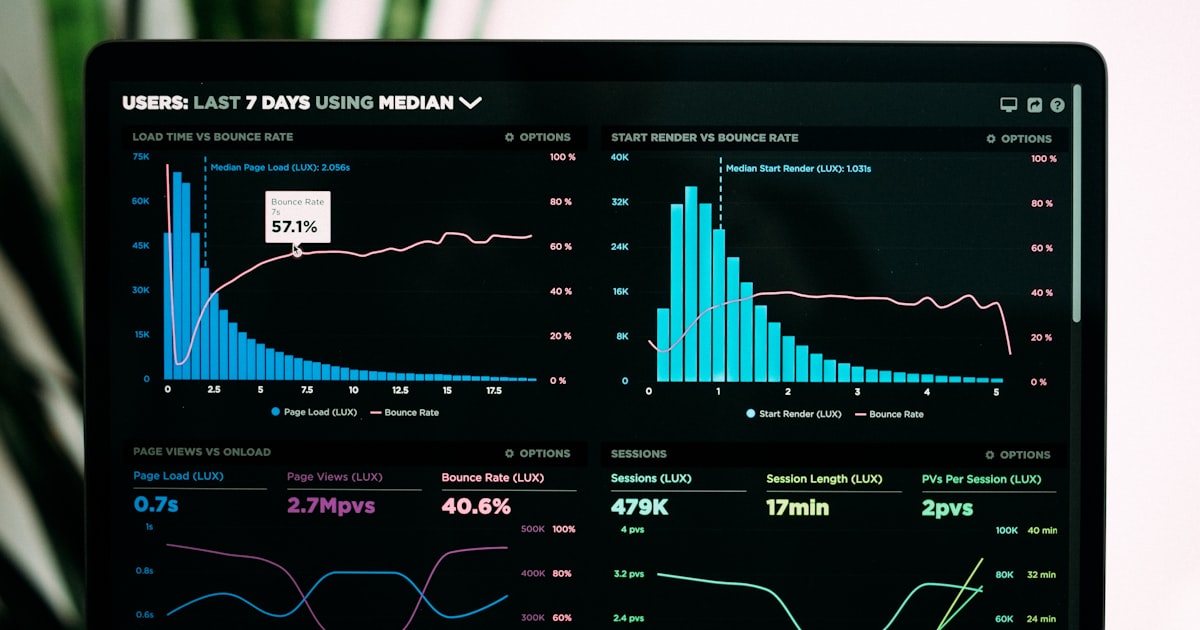
Cover photo via Unsplash / Luke Chesser.
TL;DR:
- An AI agent for Meta ads reporting pulls your data, analyzes it, and flags problems on a schedule — a dashboard just displays numbers and waits for you.
- Social media marketers spend about 3.8 hours a week on data analysis and reporting (MarketingCharts/MarketingProfs) — most of that is mechanical and automatable.
- Build the spine in four steps: connect the Meta Marketing API Insights endpoint, define analysis logic, set a cadence, and keep a human verifying outputs.
- Gartner predicts 40%+ of agentic AI projects get canceled by end of 2027 (Gartner, 2026) — so scope it tight and keep every number verifiable.
Here’s the part of the job nobody puts on a sales deck: it’s Monday morning and you’re copying numbers out of Ads Manager into a spreadsheet, eyeballing whether CPA crept up, and writing the same “here’s what happened last week” note you wrote seven days ago. In the accounts I run, that ritual used to eat the best hours of the week. And about 44% of marketers analyze performance weekly (HubSpot, 2026), so I’m not alone.
The problem isn’t only time. Manual reporting is where errors creep in — a fat-fingered cell, a stale date range, a metric pulled from the wrong attribution window. An AI agent fixes both. It pulls the data, runs the analysis, and pings you when something’s actually wrong. I’m an ex-Meta performance marketer running 8-figure DTC accounts, and this is the exact workflow I run. Let me show you how to build it.
What Is an AI Agent for Meta Ads Reporting (and How Is It Different From a Dashboard)?
An AI agent for Meta ads reporting is software that pulls your ad data, analyzes it against rules you define, and acts — sending a digest or flagging an anomaly — without you opening anything. A dashboard only displays. That gap matters more in 2026, when 76% of marketers use at least one form of AI but just 13% use agentic AI (Salesforce, State of Marketing 2026). Most people are still looking at charts, not delegating the looking.
Think of it this way. A dashboard is a thermometer — it shows the temperature. An agent is a thermostat — it reads the temperature and does something when it crosses a line. If you want the dashboard layer first, I built that out in my guide to AI-powered Meta ads reporting, and the broader analytics view in AI Meta ads analytics. This post is the layer above both: the workflow that runs the analysis for you.
So why bother building the agent at all when a dashboard already shows the numbers?
Why Automate Your Meta Ads Reporting Workflow?
Because the manual version is slow, repetitive, and quietly error-prone. Social media marketers spend roughly 3.8 hours a week on analysis and reporting (MarketingCharts/MarketingProfs), and most of that work is the same copy-check-summarize loop every week. Worse, it usually runs through spreadsheets — and decades of audit research found an average cell error rate near 5.2%, with most audited spreadsheets containing at least one error (Panko, academic). You’re not just losing hours. You’re making decisions on numbers that might be wrong.
Automating the workflow off the spreadsheet removes both problems at once. The agent reads straight from the source and applies the same logic every single run. No drift, no typos, no forgotten tab.
There’s a reality check built into that chart, and it’s the honest counterweight to the hype. Gartner expects 40% of enterprise apps to feature task-specific agents by end of 2026, up from under 5% in 2025 (Gartner, Aug 2025). But the same firm predicts 40%+ of agentic AI projects will be canceled by end of 2027 (Gartner, 2026). Here’s the lesson I take from that: the projects that fail are the ones scoped too broad and trusted too blindly. A reporting agent with a narrow job and verifiable outputs is exactly the kind that survives.
How to Build the Workflow, Step by Step
The workflow has one spine: a data source feeds an analysis loop, the loop runs on a cadence, and a human checks the output. You can build it on Claude, ChatGPT, or a no-code tool — but the four steps don’t change. Salesforce found just 13% of marketers use agentic AI in 2026 (Salesforce, State of Marketing 2026), so getting this scaffolding right puts you ahead of most accounts. Here’s the build.
Step 1 — Connect the Data Source
Everything starts with the Meta Marketing API Insights endpoint — the documented, stable way to pull ad performance data programmatically (Meta for Developers). Use the current Marketing API version and request only the fields you’ll act on: spend, impressions, CTR, CPA, ROAS, plus the breakdowns you care about. Don’t dump everything. A tight field list keeps the agent’s analysis fast and its outputs auditable.
How does the agent actually reach that endpoint? Two common paths. You can call the API directly with a script, or you can connect through MCP — the Model Context Protocol, an open standard for wiring agents to external data and tools, open-sourced by Anthropic in November 2024 and now broadly supported (Anthropic). To be clear: Meta hasn’t shipped an official MCP server. A few community/third-party MCP servers exist for the Marketing API, but the actual data source is always the Insights endpoint. I unpack this connector layer in how AI connectors are reshaping the Meta ads workflow.
Step 2 — Define the Analysis Logic
This is where most of the value lives. Tell the agent exactly what to look for, in plain rules. The core checks I run: spend anomalies (today’s pacing versus the trailing 7-day average), CTR and CPA decay week over week, creative fatigue thresholds (frequency climbing while CTR drops), and attribution-window comparisons so you’re not fooled by a 1-day-click number that looks great in isolation.
Write the logic as if you’re briefing a junior analyst. “Flag any ad set where 3-day CPA is more than 20% above its 14-day CPA.” Specific thresholds beat vague instructions every time. For the attribution piece specifically, lean on a real framework — I laid one out in building a Meta ads measurement framework beyond last-click.
Step 3 — Set the Reporting Cadence and Format
Run two cadences, not one. A daily anomaly ping catches fires — a budget runaway, a sudden CTR collapse — in a one-line alert you can act on before lunch. A weekly digest handles the trend story: what’s scaling, what’s fatiguing, what to kill. Given that roughly 44% of marketers only review weekly (HubSpot, 2026), the daily layer alone is an edge.
Keep the format boring and consistent. Same metrics, same order, same place every time. Boring formats are scannable, and scannable reports actually get read.
Step 4 — Keep a Human in the Loop
Never let the agent be the final word on a number. Build a verification layer: the agent must cite the exact metric and date range behind every claim, so you can spot-check it against Ads Manager in seconds. This guards against the failure mode that kills these projects — a hallucinated metric that reads confidently and is simply wrong. The human isn’t doing the analysis anymore. The human is auditing it.
What Should the Agent Actually Flag?
It should flag the handful of things that change a decision, and stay quiet on the rest. Alert fatigue kills these workflows fast — if the agent pings you about noise, you’ll mute it within a week. The thresholds below are the qualitative starting points I use in the accounts I run; tune them to your own volume and margins.
- Spend anomalies: daily spend more than ~25% off its trailing 7-day pace, in either direction. Overspend and underspend both cost you.
- CPA/CTR decay: a clear week-over-week deterioration on a meaningful spender, not a one-day blip.
- Creative fatigue: frequency climbing while CTR slides on the same ad — the classic fatigue signature.
- Attribution mismatches: a metric that looks great on 1-day-click but falls apart on 7-day, which usually means the win is softer than it looks.
Here’s the insight that took me a while to trust: the agent’s real job isn’t to find everything. It’s to protect your attention. A report that surfaces three things worth acting on beats one that lists forty metrics and forces you to do the triage yourself. Restraint is the feature.
Where These Agent Workflows Break (and How to Keep Yours Honest)
They break in predictable ways, and that Gartner cancellation forecast — 40%+ of agentic AI projects scrapped by end of 2027 (Gartner, 2026) — is mostly a story about avoidable failures. In the accounts I run, three failure modes account for nearly all of it: hallucinated metrics, stale data, and over-trust. Each has a cheap fix if you build for it from day one.
Hallucinated metrics are the scary one. An agent can invent a clean-looking CPA that never existed. The fix is the verification layer from Step 4 — force citations, spot-check, never let an uncited number drive a budget move.
Stale data is sneakier. If the API call fails silently and the agent reports on yesterday’s cache, you’ll act on a ghost. Make the agent timestamp every pull and refuse to report if the data is older than your cadence window.
Over-trust is the human failure. The first few weeks the agent is right, you relax, and you stop checking. That’s exactly when the missed edge case bites. The honest version of this workflow keeps a human auditing forever — not because the agent is bad, but because the stakes are your ad budget. Scope it tight, keep it verifiable, and it’ll outlast the projects that didn’t.
Related: How to Measure Incremental Conversions in Meta Ads (2026).
Frequently Asked Questions
Which AI agent should I use to build this?
Any capable model works — Claude, ChatGPT, or Perplexity can all run the analysis loop. The differences show up in connector support, context handling, and how well each cites its sources. I compared them head-to-head for Meta ads work in this 2026 breakdown, which is the best place to pick one.
Do I need to code to build a reporting agent?
Not necessarily. You can call the Meta Marketing API directly with a script, or use a no-code connector that handles the API plumbing for you. The hard part isn’t code — it’s defining clear analysis logic and a verification step. If you can brief a junior analyst in plain English, you can write the rules an agent needs.
Is it safe to let an agent pull my ad data?
Yes, when you scope access tightly. Use read-only API access, request only the fields you’ll act on, and never hand over write permissions or billing controls. The Meta Marketing API uses token-based access you can revoke anytime (Meta for Developers). Treat the token like a password and keep the agent’s job narrow.
How is this different from Meta’s built-in reporting?
Meta’s built-in reporting shows you data when you open it and ask. An agent runs without you, applies consistent logic every time, and pushes alerts to you. Built-in reporting is reactive; the agent is proactive. They’re complements — Ads Manager is your source of truth, the agent is your early-warning system on top of it.
How often should the reporting agent run?
Two cadences. A daily anomaly check catches fast-moving problems like budget runaways, and a weekly digest handles trend analysis and creative decisions. Given that about 44% of marketers only review weekly (HubSpot, 2026), the daily layer is where most of the competitive edge comes from.
Start With One Report, Then Let It Run
Don’t try to automate your whole reporting stack on day one — that’s exactly the over-scoped ambition Gartner expects to sink 40%+ of agentic projects (Gartner, 2026). Pick one report you write every week, the one that bores you most, and hand that single job to an agent. Connect the Insights endpoint, write three or four flag rules, set a cadence, and keep checking its math for a couple of weeks.
Once you trust it on that one report, the rest is repetition. Add the daily anomaly ping, then the creative-fatigue check, then the attribution comparison. Before long the Monday-morning copy-paste ritual is just gone, and you’re spending those hours on the decisions only you can make. If you want the strategic layer this reporting feeds into, start with my DTC Meta ads strategy guide for 2026. Build the small thing first. Then let it run.